
High Society, 2025.
Photography, Digital Collage.
3 of 50.8 x 33.87cm.
High Society is a body of work that employs photography and collage to interrogate the NSW Parliament building as a symbol of ideological power and constructed social normalcy. Rather than portraying the building as a static place occupied by people, meaning is inverted to represent people occupied by spaces.
Through satire, cultural iconography, and philosophical inquiry, High Society invites viewers to confront the visual language of cultural hegemony. It examines how institutional spaces influence public consciousness, subtly reinforcing dominant worldviews while marginalising dissent. These norms are challenged by manipulating familiar symbols and contemporary narratives to turn the NSW Parliament building into a site of critical reflection rather than passive reverence.
Photomontage and collage serve as tools to expose the fragility of objective decision-making. These techniques highlight the ease with which cognitive biases like stereotyping and racism can infiltrate systems of governance and perception. Conventional visual hierarchies are disrupted to destabilise the viewer’s assumptions and encourage a more nuanced engagement with power and representation.
The artist’s commitment to resistance, intertextuality, and the interrogation of what is deemed “normal” or “abnormal” positions him not just as a commentator but as a manipulator of cultural meaning that ultimately signifies the reclamation of power and a conviction to provoke dialogue and reshape narratives.
-------
Pool Party, 2025.
Photography, Digital Collage.
50.8 x 33.87cm.
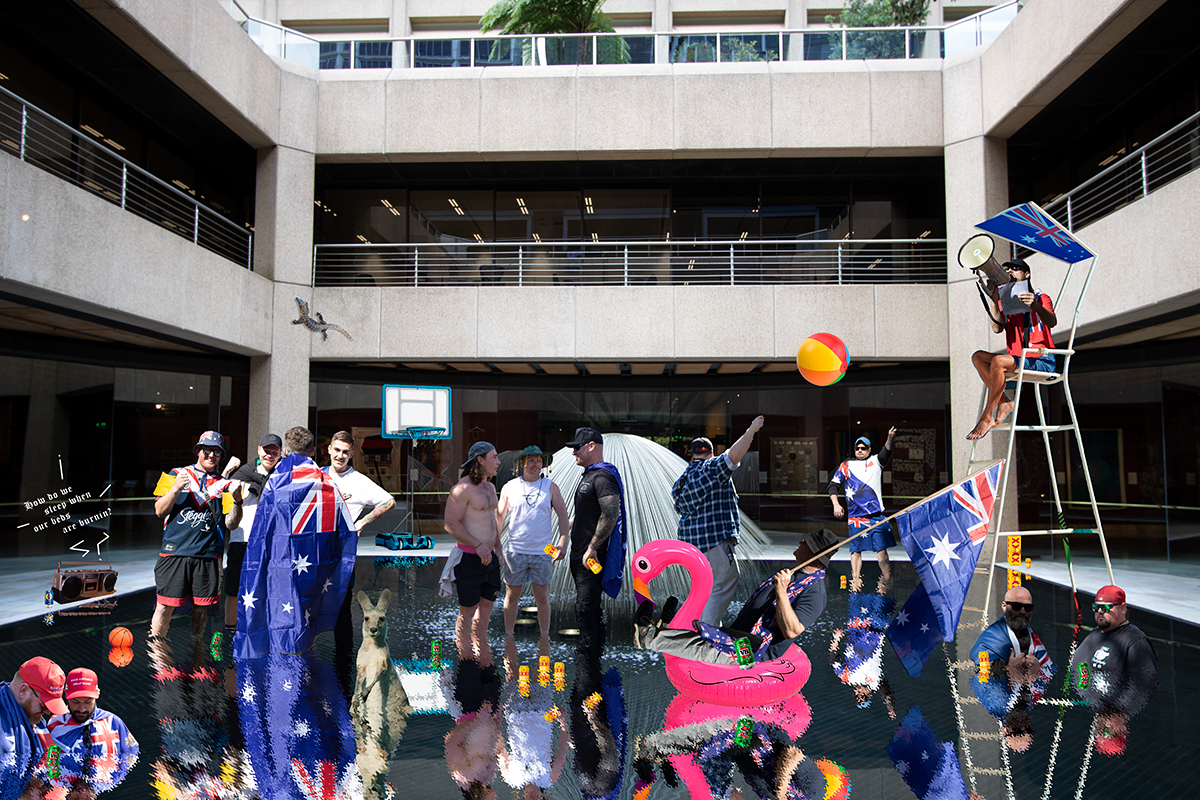
Pool Party is a cheeky intrusion into the visual language of power. Set within the Fountain Court at NSW Parliament House, a space not typically open to the public. Pool Party playfully hijacks authority, asking whether national symbols like the Australian flag still speak for a diverse society, or whether it has been co-opted to reflect only a narrow cultural script. Considering the polarities in current political discourse and public sentiment, the Australian flag takes on both positive and negative connotations.
Can you claim a “fair go for all” while opposing the other? This image sits in that contradiction, poking at the tension between inclusivity and exclusion. Through the photographic collage of images taken at a March for Australia in Sydney on the 31st of August 2025, and the placement of cultural icons in a reflection pool, Pool Party distorts and doubles them to suggest both presence and absence, unity and fracture. The Fountain Court becomes a metaphor for Australia’s self-image: shimmering, curated, and occasionally cracked.
The Parliament House, usually a backdrop for official messaging, is here reimagined as a stage for satire. Is this disrespectful? Possibly. But it’s also a challenge, a visual interruption that asks who gets to occupy space, and who gets reflected in the national mirror. Direct cultural intertextuality runs through Pool Party. Gulpilil’s boombox, for instance, doesn’t just play Midnight Oil; it marks the absence of the “other.” The boombox becomes a ghost of representation, a reminder of who’s missing from the party, and a sonic chorus that refuses silence. Pool Party is not just an image, it’s a question in costume. It invites viewers to laugh, look twice, and question who is really being served in the halls of power.
-------
The Ministers Room, 2025.
Photography, Digital Collage.
50.8 x 33.87cm.
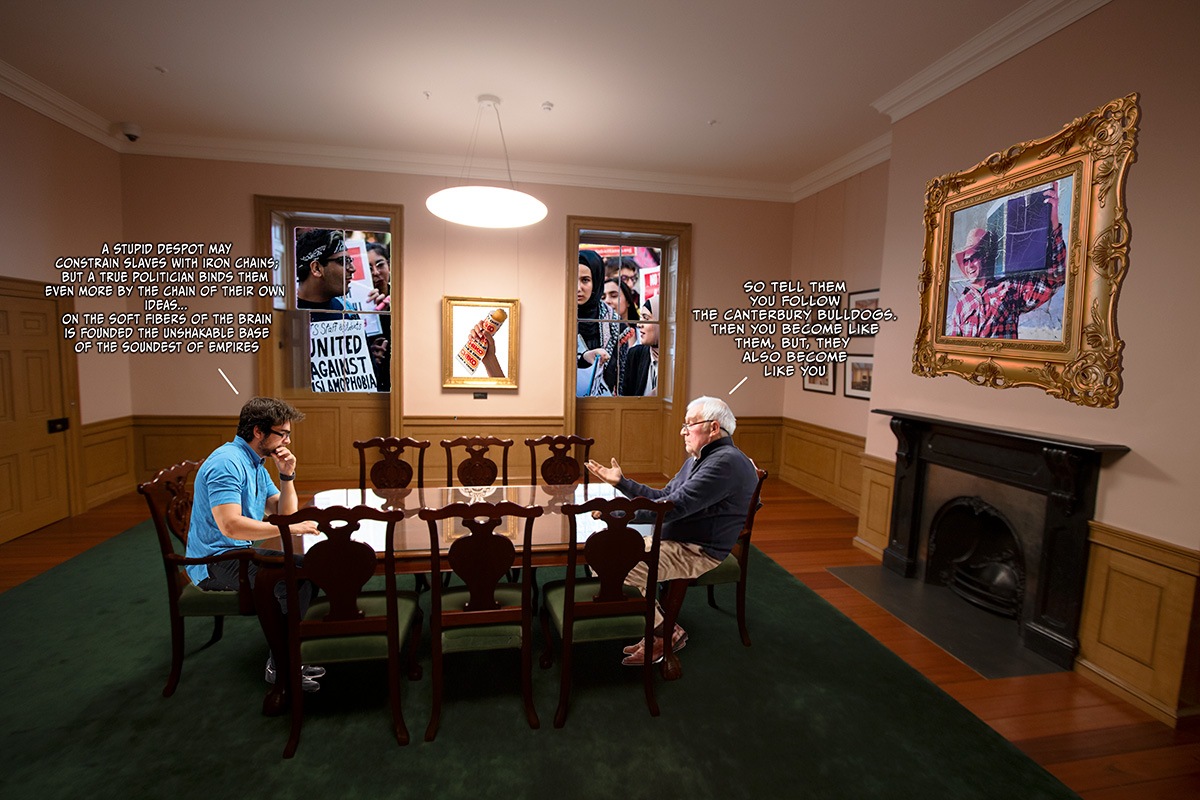
The Minister’s Room interrogates the construction of normality through a interplay of image, text, and cultural iconography. Drawing on Michel Foucault’s theories of power and the production of the “normal,” The Minister’s Room explores how people in power can construct and reinforce dominant ideologies. The image foregrounds a quote from Foucault to activate discourse around conformity and the shaping of public perception.
The concept of Bread and Circus, a Roman strategy of appeasement through spectacle and sustenance, serves as a central metaphor. Here, it is recontextualised within Australian culture, particularly in NSW, to examine how entertainment and distraction are deployed to pacify dissent and obscure systemic inequalities. The background image of people outside The Minister’s Room gestures toward contemporary debates on immigration, marginalisation, and the politics of exclusion. These figures, positioned beyond the threshold of power, embody “the other” in a society that defines itself through boundaries of belonging.
Australian iconography anchors the work in a local vernacular, linking the room and its occupants to culturally sanctioned norms. Through intertextual references to popular culture, political discourse, and theoretical texts, The Minister’s Room becomes a site of resistance that underscores the tension between agency and comfort, and critique and complacency. This work does not offer a resolution. Instead, it provokes. It asks: Who defines the normal? Who benefits from the spectacle? And what lies beyond the boundaries of sanctioned discourse?
-------
Cosmopolitan Chic, 2025.
Photography, Digital Collage.
50.8 x 33.87cm.
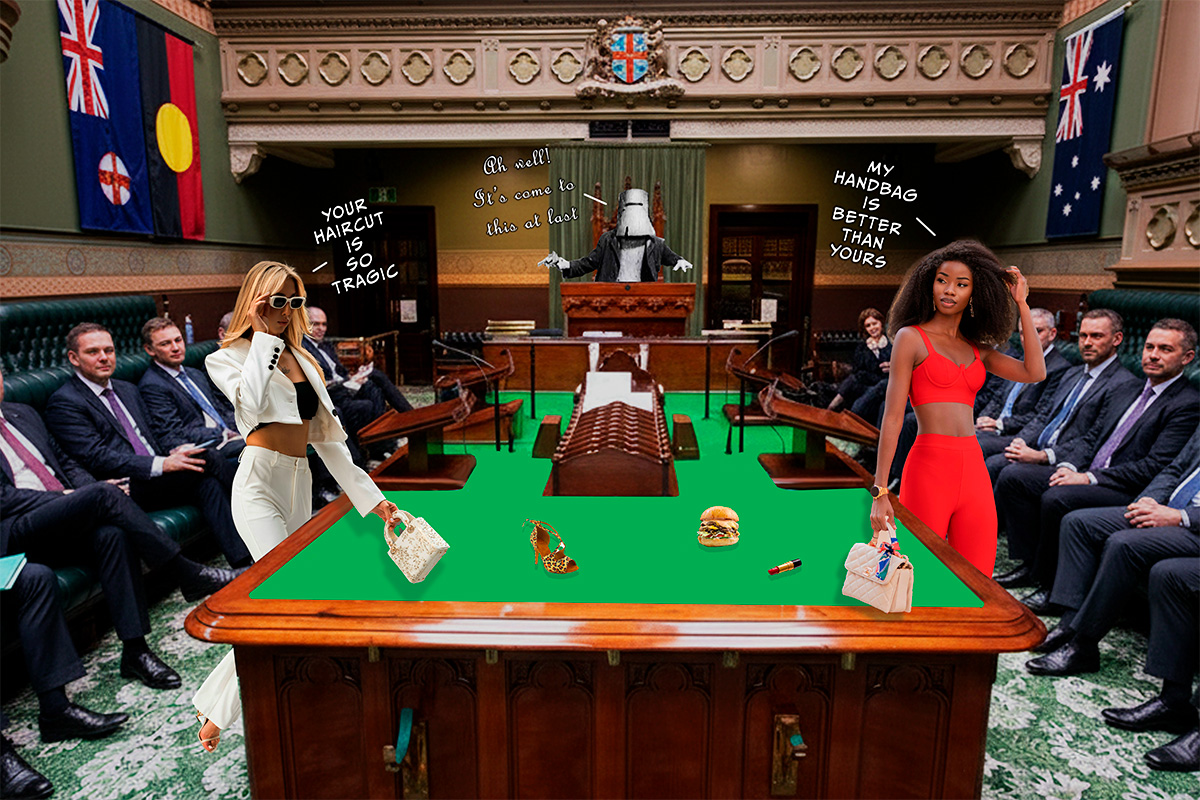
Cosmopolitan Chic draws from Michel Foucault’s theory of the normal and abnormal to interrogate the role of fashion in contemporary Sydney life. In a city where shopping ranks as the premier form of entertainment, this work critiques the dominance of fashion and food as central pillars of urban experience. At its core, the piece stages a confrontation between two antagonists who heckle and challenge each other in a battle for dominance, played out through sartorial expression. Their conflict becomes a performative struggle over ideals, values, and norms, each character reinforcing their own worldview while critiquing the other’s. Through this dynamic, Cosmopolitan Chic reveals cultural hegemony as a process of normalisation, where fashion serves as a tool for both conformity and resistance.
The work explores how advertising, consumer culture, and aesthetic codes shape public perceptions of what is desirable, acceptable, and aspirational. Fashion here is ideological, a vehicle for social control and identity formation. Ned Kelly, the iconic Australian outlaw, is cast as an arbitrator. He embodies resistance, rebellion, and the voice of the disenfranchised. His final words, “Ah well! It’s come to this at last”, echo through the work as a resigned acknowledgment of the overwhelming cultural forces at play. Kelly’s presence underscores the tension between individual agency and systemic influence, reminding us that even icons of defiance are not immune to the mechanisms of normalisation.
-------
